Web design and development · 3D
3D website development
A 3D website is a website with depth: a camera, light and objects that move with you as you scroll. Here is what it is, the kinds that exist, examples of the ones I design and build by hand in Mexico City, and what one costs.
What it is
A page that has depth
A normal website is flat: text, photos and buttons on a sheet. A 3D website has space: a camera that moves forward, objects with volume, light that changes. As you scroll you don't jump to the next section, you travel through a place. That's why 3D websites are almost always immersive websites: 3D is how the place is built, and the journey is what tells the story.
The kinds
Three ways to build a 3D website
1 · Real-time 3D
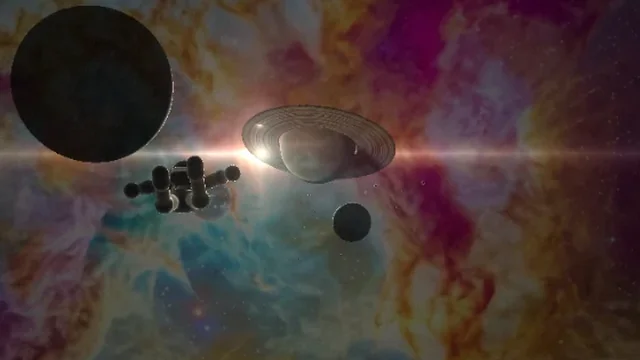
The browser draws the scene frame by frame with WebGL, so the camera can go anywhere and everything reacts on the spot. It is the most flexible kind and the one that takes the most craft. The space scene on Cauce's home page is built this way: the planets, the nebula and the astronaut are code, not images.
2 · Rendered sequence driven by the scroll
The scene is rendered beforehand, like a film of hundreds of frames, and the scroll decides which one is shown. It gives a cinematic finish with very little strain on a phone. The hangar opening in Pacífico Azul is 241 frames, and the crest the cedars grow out of in Cedros International School is 192.
3 · Interactive 3D scene
An object or a space the visitor rotates, touches or explores: a product, a model, a call to action. The Cedros website closes with one of these scenes.
One project can combine all three. The choice depends on what the visitor should feel and how much the page can weigh.
Examples
Built by Cauce
Cauce — the studio
A descent from deep space to the sea floor. Real-time 3D written by hand.
Travel it →Pacífico Azul
Proposal pending approval
Private aviation: the hangar opens with the scroll and a map traces the flight route.
See the case study →Cedros International School
Pending approval by school leadership
A school whose crest draws itself as you scroll, and the cedars grow out of it.
See the case study →The price
What it costs
Cauce quotes per scene. For international projects the main scene starts at $2,500 USD and includes custom design, development, animation and 3D when the project calls for it, domain and hosting for the first year and three rounds of adjustments; clients in Mexico are quoted in pesos plus IVA. Scenes added later cost less, because the world is already built.
What moves the price most on a 3D website is how much real 3D it has: a transition doesn't cost the same as a free camera in real time, and modelling a product from scratch is quoted separately. Product configurators and advanced 3D experiences are custom solutions. The full breakdown is on the pricing page.
Who it's for
When it's worth it and when it isn't
It's worth it when the first impression decides the sale: a product launch, the pre-sale of a development that doesn't exist yet, a hotel or restaurant that has to be felt before booking, a brand that wants to tell its whole story.
It isn't if what you need is to publish articles every week or a catalog of hundreds of products that change on their own. Another tool suits you better, and I'll tell you so from the first conversation.
Performance
Looks good and loads fast
- Separate images for phones: the Pacífico hangar sequence weighs 2 MB on a phone instead of 12.8 MB.
- Progressive loading: the scene shows with whatever arrives first and the rest follows in the background.
- Adaptive resolution: real-time 3D lowers its quality only if the device can't keep up.
- Text readable without the 3D: the content lives in the HTML, so search engines and AI assistants read all of it.
- Reduced motion: anyone who asks for it in their system, or with the switch in the menu, sees the page still.
Questions
Frequently asked questions
What is a 3D website?
It is a website where the design has depth: objects, camera, light and movement in three dimensions, instead of only flat text and images. It can be real-time 3D, drawn by the browser frame by frame; a rendered sequence that moves with the scroll; or an interactive 3D scene you can rotate or touch.
How much does a 3D website cost?
At Cauce, a website built around one main scene starts at $2,500 USD for international projects, and includes custom design, development, animation and 3D when the project calls for it, domain and hosting for the first year and three rounds of adjustments. Anything beyond storytelling, such as product configurators or advanced 3D experiences, is quoted separately, in writing, before we start.
Is a 3D website slow on a phone?
It doesn't have to be. Phones get lighter images than computers, the scene shows with whatever arrives first while the rest loads in the background, and real-time 3D lowers its resolution only if the device can't keep up. Anyone with reduced motion turned on sees the page without animation.
Can Google read a 3D website?
Yes, if it is built well. On Cauce's websites the text lives in the HTML, not drawn inside the 3D, so search engines and AI assistants read all of it even though they don't see the animation.
Do I need 3D models of my product?
Not necessarily. If you already have renders or models, for example from your architect or manufacturer, they are reused. Some scenes are solved with code and light alone, like the space scene on this site's home page. If your product has to be modelled from scratch, that is quoted separately.
Who builds 3D websites in Mexico?
Cauce is the studio of Johonatan Cordero, a web designer in Mexico City. He designs and codes immersive and 3D websites by hand, without templates, for brands where the first impression decides the sale. Work is done in Spanish and English, remotely.
Contact
Would your brand look good in 3D?
Tell me in one line and I'll tell you which kind of 3D suits it. The first conversation is free.
or by email johonatan@encauzar.com